Three Core Algorithms That Power Modern AI
Published January 19, 2026
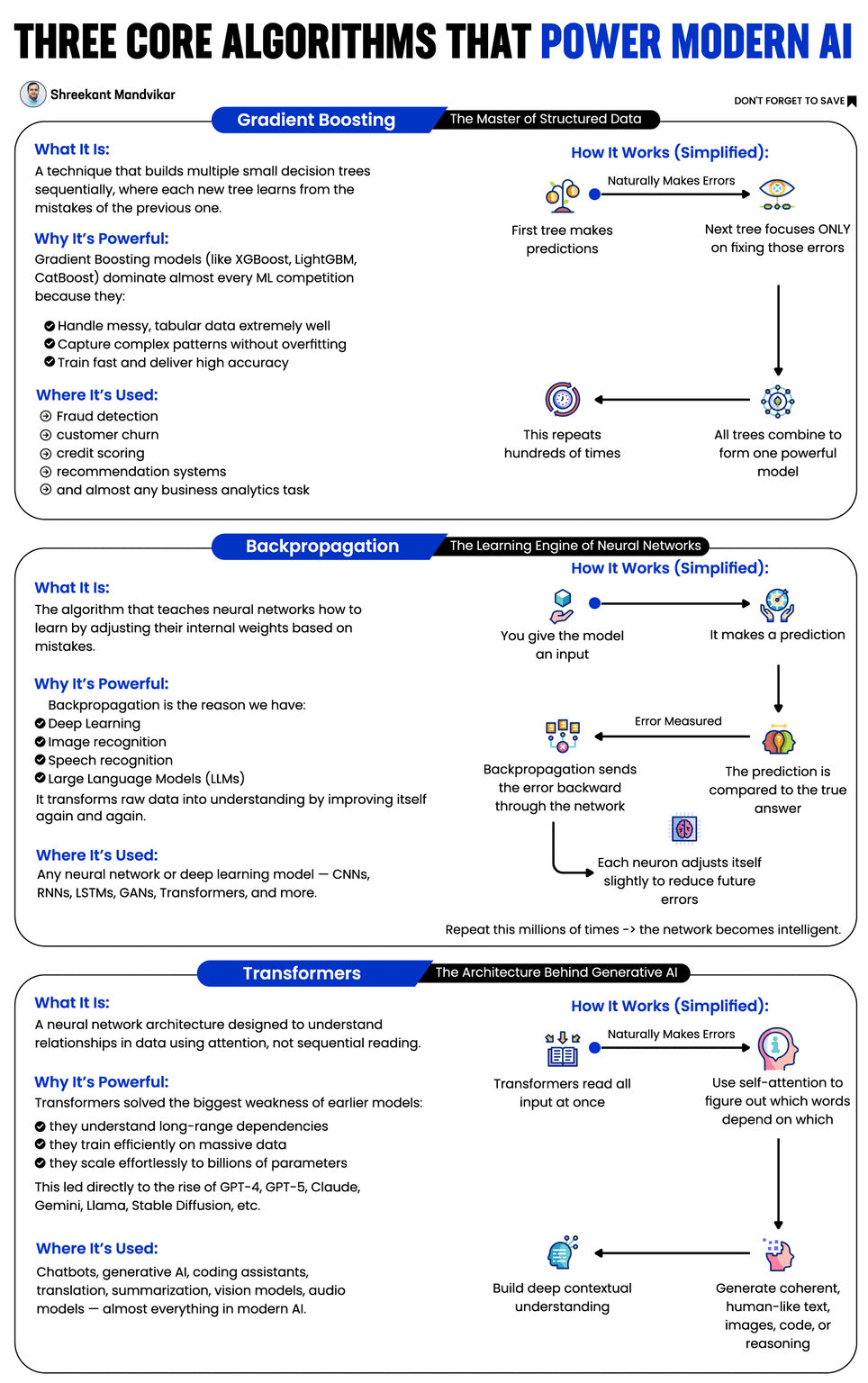
Three Core Algorithms That Power Modern AI Modern AI systems are not driven by a single breakthrough, but by a combination of foundational algorithms—each solving a specific class of problems at scale.
-
Gradient Boosting — Master of Structured Data Designed for tabular and business data, gradient boosting builds models sequentially, where each iteration learns from previous errors. Impact: High accuracy, strong generalization, and dominance in real-world ML use cases such as fraud detection, credit scoring, and churn prediction.
-
Backpropagation — Learning Engine of Neural Networks Backpropagation enables neural networks to learn by continuously adjusting internal weights based on prediction errors. Impact: The core reason deep learning works—powering image recognition, speech systems, and large language models.
-
Transformers — Architecture Behind Generative AI Transformers leverage self-attention to understand context across entire inputs simultaneously. Impact: Efficient scaling, long-range understanding, and the foundation of models like GPT, Gemini, Claude, and modern multimodal AI.
Why This Matters Together, these algorithms form the backbone of today’s AI ecosystem—spanning structured analytics, deep learning, and generative intelligence. Understanding them is essential for anyone building, deploying, or leading AI-driven systems. #ArtificialIntelligence #MachineLearning #GenerativeAI
Originally posted on LinkedIn · 156 likes · 17 comments