Small Language Models (SLMs): The Next Wave of Efficient AI
Published January 30, 2026
Small Language Models (SLMs): The Next Wave of Efficient AI As AI adoption scales, efficiency is becoming as critical as raw capability. This is where Small Language Models (SLMs) are emerging as a practical alternative to large, general-purpose LLMs.
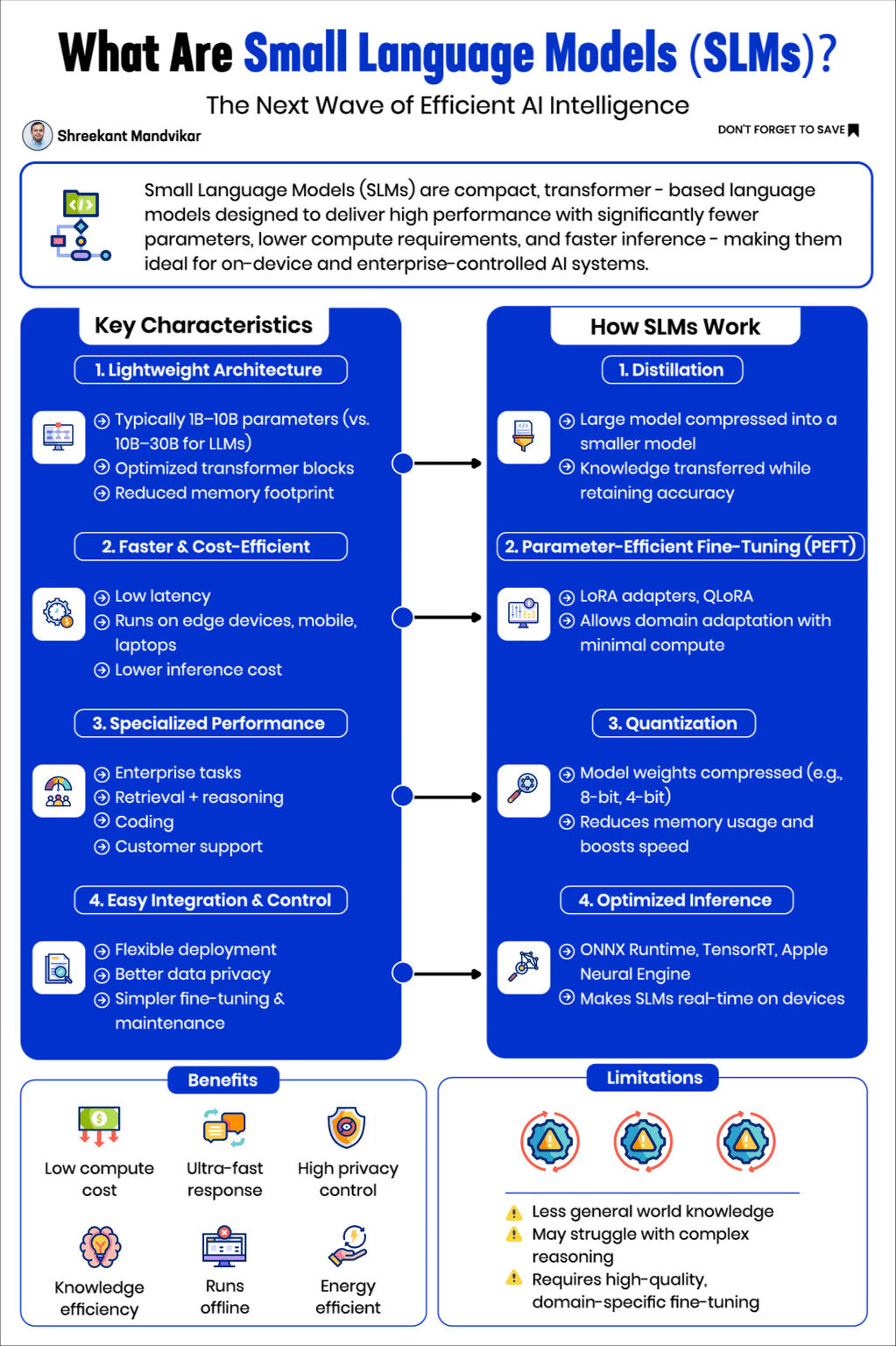
What Are SLMs? SLMs are compact, transformer-based models designed to deliver strong performance with significantly fewer parameters, lower compute requirements, and faster inference—making them ideal for on-device and enterprise-controlled deployments.
Key Characteristics Lightweight architecture: Smaller parameter counts, optimized transformer blocks, reduced memory footprint
Faster and cost-efficient: Low latency, lower inference cost, runs on edge devices and mobile hardware
Specialized performance: Well-suited for enterprise tasks, retrieval, reasoning, coding, and customer support
Greater control: Easier integration, better data privacy, and simpler fine-tuning and maintenance
How SLMs Work Distillation: Knowledge transferred from large models into smaller ones while retaining accuracy
Parameter-efficient fine-tuning (PEFT): Techniques like LoRA and QLoRA enable domain adaptation with minimal compute
Quantization: Reduced precision (e.g., 8-bit, 4-bit) for faster, memory-efficient inference
Optimized inference: Deployment via runtimes like ONNX, TensorRT, and device-level accelerators
Why This Matters SLMs enable ultra-fast, privacy-aware, and energy-efficient AI—especially where latency, cost, and control matter more than broad generalization. #SmallLanguageModels #EdgeAI #EnterpriseAI
Originally posted on LinkedIn · 21 likes · 4 comments